A survival guide for coordinators who need their CTE advisory committee to do real work — review curriculum, open employer doors, and actually show up.
If you've ever sat in an empty conference room at 7:30 AM, staring at the muffins you bought for an advisory meeting that three people are going to attend, you know exactly what this article is about.
Perkins V (Section 134(b)(3)) requires your program to consult with stakeholders — including representatives from business and industry, labor organizations, parents, students, and special populations. Your state plan probably reinforces this with specific advisory committee language. Most coordinators read that and dutifully stand up a committee. And then most of those committees quietly die.
This isn't a compliance article. It's a survival guide for coordinators who need their advisory committee to do real work — review curriculum, validate skill standards, open employer doors, fight for budget, and signal to your superintendent that industry actually cares about your program. Here's how to build one that shows up.
Why Most Advisory Committees Fail
Before we get to the fix, let's name the problem honestly. The typical CTE advisory committee fails for a small set of predictable reasons:
- No clear purpose. Members were recruited with vague language ("we'd love your input on our program") and have no idea what they're supposed to do.
- Bad meeting hygiene. Meetings start late, have no agenda, run long, and produce no decisions or follow-up.
- One-way information flow. The coordinator talks, the committee listens, everyone nods, nothing changes.
- Wrong members. You recruited whoever said yes — usually friends of friends, retired industry folks, or your most enthusiastic employer partner — rather than the people who can actually move the needle.
- No social glue. People don't feel ownership. They're attending out of obligation, not investment.
If two or more of those describe your committee, that's the diagnosis. Now the treatment.
Step 1: Define the Job Before You Recruit
Don't recruit until you can answer this question in one sentence: "What is this committee responsible for producing this year?"
Strong examples:
- "This committee will validate the skill standards for our new Health Science pathway, secure 15 clinical placement sites, and review program-of-study data twice this year."
- "This committee will help us reach 40% paid WBL placements (up from 22%) by opening doors to three new employer-of-record partners and reviewing our wage equity data."
Notice these aren't aspirational mission statements. They have outputs, numbers, and a time horizon. That clarity does three things: it makes recruitment easier (you can pitch a real job), it focuses meetings on the deliverable, and it gives you something to celebrate at year-end.
If you can't articulate the job, your committee can't either — and they'll quietly tune out.
What Perkins V Actually Requires
To anchor this in compliance: Perkins V requires consultation, not specifically a single committee. But the comprehensive local needs assessment (CLNA) is where this work shows up. Your advisory committee can be the engine that:
- Reviews labor market information (LMI) and identifies in-demand occupations
- Validates that programs of study align with industry skill needs
- Evaluates progress on the four CLNA elements (student performance, size/scope/quality, recruitment/retention/training, equity)
- Provides documented stakeholder input that feeds your local application
If your committee output maps to the CLNA, you've made your own life easier come reporting season — and you've given members a sense that their time is feeding something bigger than a 90-minute meeting. (For more on the reporting side, see our guide to WBL reporting and compliance.)
Step 2: Recruit for Roles, Not Just Names
The single biggest upgrade you can make is recruiting by role, not by availability. Build a committee composition matrix before you start asking anyone to join.
A working composition matrix for a multi-pathway CTE program might look like:
| Role | Pathway/Sector | Why They're There |
|---|---|---|
| HR Director, mid-size local employer | Pathway A | Opens employer doors, gives hiring perspective |
| Hiring Manager, small business | Pathway A | Ground-truth on entry-level skills |
| Skilled tradesperson / journey-level worker | Pathway B | Validates technical skill standards |
| Union/apprenticeship rep | Pathway B | Pre-apprenticeship articulation, JATC pipeline |
| Postsecondary partner (community college dean or program lead) | Cross-cutting | Articulation, dual enrollment |
| Workforce board member or WIOA youth provider | Cross-cutting | Connects to public workforce system |
| Parent of a current CTE student | Cross-cutting | Family/community voice |
| Recent program completer (1-3 years out) | Cross-cutting | Authentic student experience |
| Special populations representative (transition specialist, EL coordinator, or community-based org) | Equity | Required by Perkins V; voice for underserved students |
| Economic development professional | Cross-cutting | Regional pipeline view |
Notice what's missing: friends of the program who don't fill a role. You can still keep them in the loop as supporters, but they don't take an advisory seat.
Make the Ask Specific
When you reach out, do not say "We'd love to have you on our advisory committee." Say:
"We're looking for a hiring manager at a regional manufacturer who can help us validate the skill standards for our Mechatronics pathway and signal to other employers that this program is worth investing in. We meet three times a year, no more than 90 minutes, and we will not waste your time. Are you interested or can you point us to the right person?"
A specific ask gets a specific answer. A vague ask gets ghosted.
Step 3: The Calendar Is the Strategy
Now the practical part. Three rules:
- Set the entire year's meeting dates at the first meeting. Locked dates, twelve months out, on the calendar invite. People can't claim a conflict if they had a year of notice.
- Three meetings per year is plenty. September (kick-off + CLNA review), February (mid-year data + employer recruitment push), May (year-end review + planning). More than that and attendance craters.
- 90 minutes, hard stop. Start on time. End on time. Industry people respect time more than anything else you can offer them.
Within each meeting, follow a tight rhythm. Here's a structure that works:
- 0:00–0:05 — Welcome, agenda, "what's at stake today"
- 0:05–0:20 — 15-minute data spotlight (one chart, one story, one question)
- 0:20–0:50 — Working session on the deliverable (small groups if committee is larger than 8)
- 0:50–1:10 — Decision time: what are we recommending/committing to?
- 1:10–1:25 — Action items with owners and dates
- 1:25–1:30 — Quick close, next meeting reminder
Notice that "coordinator updates the committee on what happened" is not on the agenda. Send that as a one-page pre-read 72 hours before the meeting. The meeting is for work, not for status reports.
Step 4: Give Them Something Real to Do
Committees die when there's no work. Here are concrete, valuable jobs you can hand to them:
Pathway Standards Validation
Bring one program's competency list to a meeting. Print it. Have industry members mark which skills are essential, useful, or missing. You'll get a calibrated standards review in 30 minutes that would take you a month of survey-chasing.
Employer Recruitment Pod
Form a 3-person sub-committee tasked specifically with opening doors to new WBL host sites. Their job is not to host students themselves — it's to make warm introductions to peers. Set a target ("five new host sites this year") and report progress at each meeting. If you're trying to grow placements, our guide to scaling WBL opportunities pairs well with this.
Mock Interview & Portfolio Review Days
Twice a year, invite committee members to spend a half-day reviewing student portfolios or running mock interviews. This is high-impact for students and low-lift for members — and it builds emotional connection to your program in a way no PowerPoint can.
Equity Data Review
Pull disaggregated WBL placement data (by race/ethnicity, gender, IEP/504 status, EL status, free/reduced lunch). Show it to the committee. Ask: "Where are we falling short, and what would you do?" Industry members often have insights about their own hiring funnels that translate directly to WBL pipelines.
Advocacy at the Board Level
Once or twice a year, ask one or two advisory members to attend a school board meeting and speak briefly about why CTE matters to local industry. Board members hear from teachers all the time. They rarely hear from a hiring manager who says, "I need these graduates."
Step 5: Track Engagement Like You Track Anything Else
You measure WBL hours. You measure placements. You measure credential attainment. Why are you not measuring advisory engagement?
A simple engagement scorecard:
- Meeting attendance rate (target: 75% or higher)
- Number of warm introductions made by members per year
- Number of host sites opened through committee channels
- Number of standards/curriculum reviews completed
- Member retention year over year (target: 70%+ rolling over)
If a member has missed two consecutive meetings and made zero introductions, that's data. Have a conversation. Sometimes life gets in the way and you re-engage them; sometimes it's time to graciously rotate them off and recruit a more active member.
This is also where a system like WBL Tracker can quietly do work for you: when your placement, hours, and disaggregated equity data are already aggregated in one place, advisory meetings become about the data instead of waiting on the data. You walk in with the report instead of trying to assemble it the night before.
Step 6: Close the Loop, Visibly
The fastest way to lose an advisory member is to take their input and then never tell them what you did with it.
After every meeting, send a one-page recap within 72 hours that includes:
- Decisions made
- Action items with owners and due dates
- What changed in the program as a result of last meeting's input
That last bullet is the secret weapon. When a committee member sees "Because Maria's feedback in February, we added a forklift safety module — 28 students have completed it" in writing, they understand their time mattered. They show up next time. They tell their colleagues. They become recruiters for the committee.
A Few Failure Modes to Avoid
A short list of things that will erode your committee fast:
- Letting it become a complaint forum. If every meeting becomes a list of grievances from one or two members, redirect to deliverables or your committee dies.
- Letting administrators dominate. Your principal/superintendent should attend occasionally as a sign of support, not run the meeting. Industry voices should outnumber school voices in airtime.
- Recruiting only "yes" people. You need members who will push back. A committee that rubber-stamps everything you do is providing no value.
- Skipping equity voice. Your special populations representative is not a checkbox. Build the relationship year-round, not just before the CLNA cycle.
- Going dark between meetings. Three touches a year is the floor for meetings, but you should be emailing the committee — short, specific updates — at least monthly.
A 30-Day Reboot Plan
If you're reading this and quietly realizing your committee is on life support, here's a 30-day reboot:
- Week 1: Write the one-sentence job description for the committee this year. Identify the three deliverables. Build the composition matrix.
- Week 2: Audit current members against the matrix. Identify gaps. Draft personalized recruitment asks for the missing roles.
- Week 3: Reach out to existing members with a renewed pitch and ask them to either re-up for a specific role or step aside gracefully. Send recruitment asks to new candidates.
- Week 4: Schedule the next 12 months of meetings. Send a real agenda with a real deliverable. Show up prepared.
You don't need to rebuild from zero. You need to clarify the job, recruit for roles, and respect everyone's time.
The Takeaway
A CTE advisory committee is one of the highest-leverage assets a coordinator has — if it's built around a clear job, recruited by role, run with discipline, and given real work to do. Stop treating it as a compliance ritual. Treat it like a kitchen cabinet of industry talent that's volunteering to make your program better.
Then close the loop, show them the impact, and watch the same people who used to skip your meetings start bringing colleagues to the next one.
That's the goal. Not a bigger committee. Not a fancier room. Just a group of the right people who actually show up — and who walk out having done something that matters.

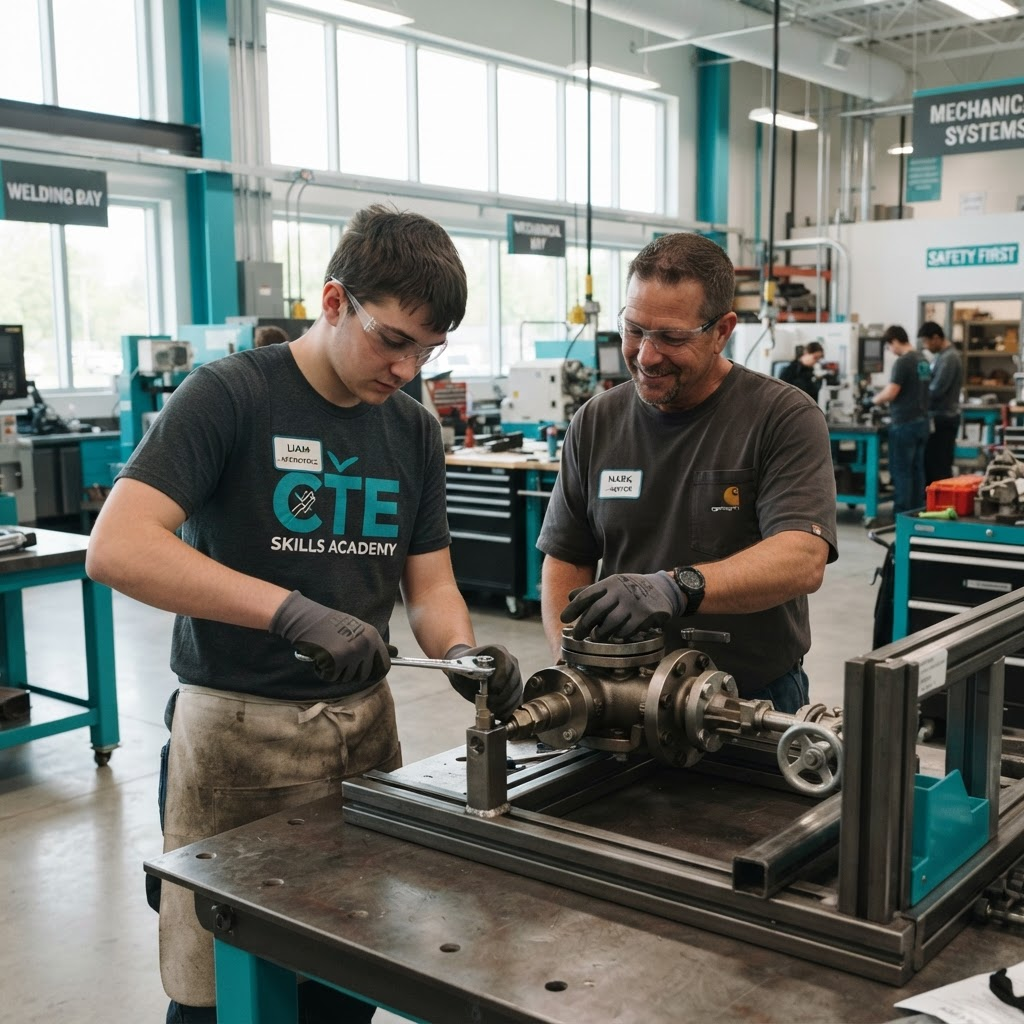
Students collaborating in a work-based learning environment
About the Author
WBL Tracker Team
Education Technology Experts
The WBL Tracker team consists of former educators and coordinators who understand the challenges of managing work-based learning programs. We're dedicated to helping schools save time and improve student outcomes.
Ready to Transform Your WBL Program?
Join coordinators who are saving 10+ hours per week with automated tracking and compliance reporting.