What a work-based learning coordinator does, a sample job description, core duties, and state certification rules from Georgia and New Jersey.
A work-based learning coordinator is the person who makes a district's internships, job shadows, co-ops, and apprenticeships actually happen. They recruit employers, place students, keep paperwork compliant, check on students at the worksite, and report participation to the state. If your district is creating the role, rewriting a posting, or trying to understand what credential the job requires, this guide breaks it down.
One thing up front: certification requirements for WBL coordinators are set by each state, and they differ a lot. Below we quote two states' rules directly and link to the source. Always confirm with your own state department of education before you post a job or assign staff.
If you're already in the role and building a program from scratch, see our companion post, The WBL Coordinator's First 90 Days.
What Is a Work-Based Learning Coordinator?
A WBL coordinator is a school or district staff member responsible for the planning, placement, supervision, and documentation of student work-based learning experiences. Georgia's State Board of Education rule describes the role as "school personnel with proper training required to administer Career Related Education including supervision of work-based learning placements" (Ga. Rule 160-4-3-.14).
In practice the title varies. You'll see "WBL coordinator," "cooperative education coordinator," "career coach," "internship coordinator," and "structured learning experience (SLE) coordinator." New Jersey's Department of Education noted in a 2023 rulemaking response that districts often call cooperative education coordinators "work-based learning coordinators," and that the two perform the same job functions (NJ SBOE, 2023).
Where the role sits in a district
Depending on size, a district may have:
- A building-level coordinator who teaches part-time and coordinates WBL for one high school or career center.
- A district WBL coordinator who sets policy, owns employer relationships, and supports building staff.
- CTE teachers who coordinate WBL for their own pathway, often under a CTE director.
Whichever model you use, the duties below are the same. What changes is how many students and employers each person carries.
Work-Based Learning Coordinator Job Description (Sample)
Use this as a starting point and adapt it to your state's rules and your local bargaining agreement.
Position summary
The Work-Based Learning Coordinator plans, implements, and evaluates work-based learning experiences for students in grades [9-12 / your grade band]. The coordinator develops employer partnerships, places and supervises students in approved experiences, ensures compliance with state and federal labor and safety requirements, maintains student WBL records, and reports program data as required by the state department of education.
Essential duties and responsibilities
Employer and opportunity development
- Recruit, onboard, and maintain relationships with employer partners and worksite supervisors.
- Identify and document placement opportunities, including schedules, requirements, and dress codes.
- Orient worksite supervisors to program expectations, evaluation, and safety.
Student placement and support
- Recruit and prepare students for WBL, including employability skills instruction.
- Match student placements to each student's program of study and career goals.
- Develop an individual training or learning plan with the student and supervisor (see our WBL plan template).
- Conduct worksite visits and observations; resolve issues between students and employers.
Compliance and documentation
- Execute training agreements, parent/guardian consent, and other required forms before a student starts.
- Review placements for compliance with child labor, wage-and-hour, and safety laws.
- Collect and verify student hours, supervisor evaluations, and signatures.
- Maintain accurate student records for the duration required by state and district policy.
Reporting and program improvement
- Submit required state WBL data reports.
- Analyze participation and completion data to improve the program.
- Work with CTE advisory committees, counselors, and administrators.
Qualifications
- Certification as required by state rule (see the next section).
- Teaching experience, preferably in a CTE area.
- Completion of any state-required WBL, labor law, or safety training.
- Strong communication, organization, and relationship-building skills.
- Valid driver's license and reliable transportation for worksite visits.
Work-Based Learning Coordinator Certification by State
There is no national WBL coordinator license. Some states have a dedicated endorsement, some tie the role to a cooperative education certificate, and some leave it to districts. Here are two states with clear, published rules.
Georgia
Georgia's State Board of Education Rule 160-4-3-.14 says each WBL coordinator supervising students in GaDOE-approved WBL courses must meet one of three requirements (GaDOE):
- Hold a valid Work-Based Learning endorsement (formerly DCT) issued by the Professional Standards Commission and have completed a state-approved WBL training session within the past five years.
- Hold a valid certificate in any CTAE field and have completed a GaDOE-approved WBL training session within the past five years.
- Serve as a coordinator for the Youth Apprenticeship Program only and attend a GaDOE-approved WBL training session within the past five years.
The same rule requires that the coordinator be available for worksite supervision while students are released for WBL, submit the annual Work-Based Learning Data Report, and maintain an up-to-date database of student records.
The Georgia Professional Standards Commission's endorsement rule says a holder of the Work-Based Learning Endorsement is in-field to coordinate WBL programs in grades 6-12, and eligibility starts with a level four or higher Professional or Induction certificate in a teaching field (GaPSC Rule 505-2-.183).
New Jersey
New Jersey separates two levels, per N.J.A.C. 6A:19-4.2 (text via Cornell LII) and the NJDOE Work-Based Learning Handbook:
WBL coordinator (non-hazardous experiences other than co-op and apprenticeship). The person must be assigned by the chief school administrator and:
- hold a standard instructional certificate;
- show one year of full-time, successful classroom teaching;
- complete training in child-labor, wage-and-hour, and wage-payment laws; and
- complete at least 20 hours of training (or an approved equivalent) in safety and health and in NJDOE procedures and planning for structured learning experiences.
The handbook notes that job shadowing and school-based enterprises do not require a trained coordinator.
Cooperative Education Coordinator certificate (co-op and apprenticeship). Per the NJDOE certificate page, candidates need a standard instructional certificate with a CTE endorsement, two years of successful teaching under that CTE certificate, and four NJDOE-approved courses through the New Jersey Safe Schools Program, including Designing and Implementing Student Training Plans and OSHA 10 Plus for General Industry. A separate endorsement covers hazardous occupations.
Other states
Many other states publish WBL coordinator guidance, but the details differ. Before you write a posting:
- Search your state DOE's CTE or WBL page for "coordinator" requirements.
- Check whether your state's educator licensing board lists a WBL or cooperative education endorsement.
- Ask your state CTE office whether coordinator training must be renewed, and how often.
We haven't summarized other states here because we'd rather link a primary source than generalize.
WBL Coordinator Salary
Pay is usually set by the district's teacher or administrator salary schedule, sometimes with an extended-contract stipend for summer placements. Because it depends on your district's agreement, we don't list figures here. Check your local salary schedule.
What Makes the Job Hard (and How Districts Help)
The duties above are mostly about people: students, employers, families. The part that eats coordinators' time is the paperwork around them: missing timesheets, unsigned agreements, and spreadsheets that don't match at reporting time. Georgia's rule even names keeping "an accurate, up-to-date database of student records" as a coordinator requirement.
Districts can protect the people side of the job by giving coordinators one system for:
- Student tracking. Each student's program, cohort, placements, and total hours in one record.
- Opportunity tracking. Employer contacts, schedules, requirements, and placement details.
- Time logs. Students log hours from any device, and supervisors verify them.
- E-signature. Training agreements and other forms are signed electronically, and the signed documents are stored in each student's account, so they're there when it's audit or reporting time.
That's what WBL Tracker's work-based learning software is built to do.
FAQ
What qualifications does a work-based learning coordinator need?
It depends on your state. Georgia requires a WBL endorsement or a CTAE certificate plus GaDOE-approved training within five years. New Jersey requires a standard instructional certificate, a year of teaching, and labor-law and safety training. Check your state DOE.
Is a WBL coordinator the same as a cooperative education coordinator?
Often the duties overlap. New Jersey's DOE has said districts often call cooperative education coordinators "work-based learning coordinators." Some states still treat them as separate credentials, so check your state's rules.
Does every WBL activity need a certified coordinator?
Not always. New Jersey's handbook, for example, exempts job shadowing and school-based enterprises from the trained-coordinator rule. Other states differ.
How many students can one coordinator supervise?
Some states address workload. Georgia requires a "manageable workload" consistent with CTAE class-size rules. Check your state's rule.
See It in Action
If you're writing this job description because your program is growing, give your coordinator a system that keeps up with them. Book a 30-minute demo of WBL Tracker to see student tracking, opportunity tracking, time logs, and built-in e-signature in action.

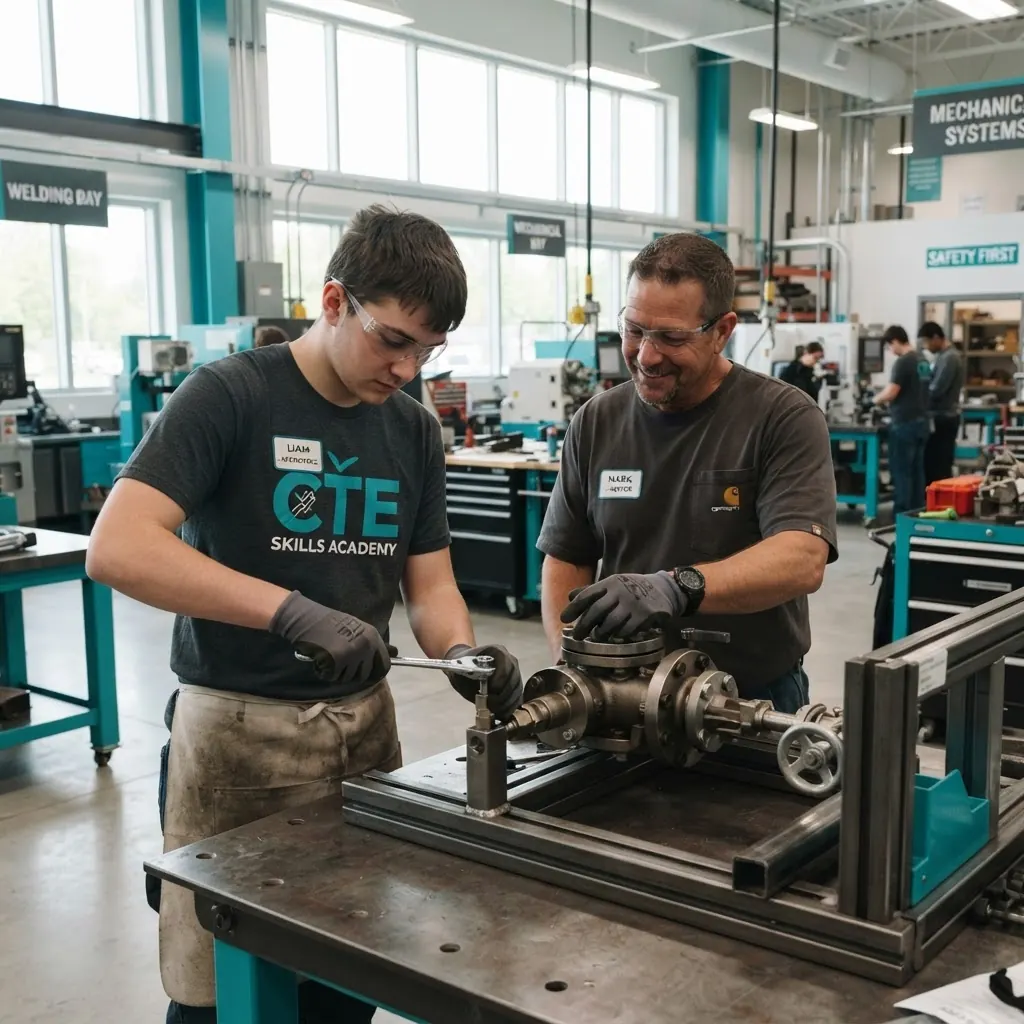
Students collaborating in a work-based learning environment
About the Author
WBL Tracker Team
Work-Based Learning Specialists
The WBL Tracker team consists of former educators and coordinators who understand the challenges of managing work-based learning programs. We're dedicated to helping schools save time and improve student outcomes.
Ready to Transform Your WBL Program?
Join coordinators who are saving 10+ hours per week with automated tracking and compliance reporting.